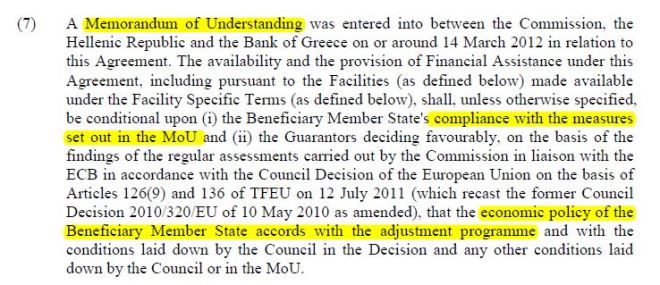
One of the major debates held within SYRIZA’s closed doors is whether the new Master Financial Assistance Facility Agreement (MFAFA) four-month extension granted by the European Financial Stability Facility (EFSF) on 27 February should be brought to the Greek Parliament for approval.
So let’s see what happened in the past:
1. Originally the MFAFA was approved by the Greek Parliament on 14 March 2012 and became law 4060/2012 of the Hellenic Republic.
2. Following a EUROGROUP decision, an amendment was again brought to the Parliament and was favorably voted on 12 December 2012. The amended official law authorized the heads of the Ministry of Finance, the Hellenic Financial Stability Fund and the Bank of Greece to sign the final draft of the MFAFA amendment after all clarifications had been addressed and all errors corrected. The Minster of Finance was obliged to present the final draft to the Parliament.
3. In a similar procedure with (2), the MFAFA was extended from 31 December 2014 to 28 February 2015. The ensuing law was again approved by the Parliament on 17 December 2014.
For now, SYRIZA claims that the three heads have the authorization to sign the new amendment and that the only obligation is for the Minister of Finance to present the amendment without any prior vote/authorization by the members of the Greek Parliament. SYRIZA’s major argument is that the extension is not a new MNIMONIO (Memorandum of Understanding) but a loan extension and therefore no vote of approval is necessary.
Here is SYRIZA’s MP and Alternate Minister of Social Security Dimitris Stratoulis explaining the official party position:
KOLOTOUMBA TAKE: In the past, SYRIZA as the opposition had always objected on the procedures described above because they were based on an ACT OF LEGISLATIVE CONTENT and voted “in haste”. No-one can imagine what would be SYRIZA’s reactions if the above laws/amendments had never received any kind of parliamentary authorization as they are proposing now.
Definition of ACT OF LEGISLATIVE CONTENT: Under extraordinary circumstances of an urgent and unforeseeable need, the President of the Republic may, upon the proposal of the Cabinet, issue acts of legislative content. Such acts shall be submitted to Parliament for ratification, as specified in the provisions of article 72 paragraph 1, within forty days of their issuance or within forty days from the convocation of a parliamentary session. Should such acts not be submitted to Parliament within the above time-limits or if they should not be ratified by Parliament within three months of their submission, they will henceforth cease to be in force.
Many thanks to K. LIDORIKIS for his analysis at http://www.kathimerini.gr/806499/opinion/epikairothta/politikh/grammata-anagnwstwn
 KOLOTOUMBA.com