One promise gone per day


2015-02-25 vima article
They forget one every day

Vassilis Chiotis, of newspaper and radio station TO VIMA, consolidated a list of 29 “abandoned promises” made by SYRIZA during its campaign that led to a 35% win in the Greek January 2015 elections.

Source: http://www.tovima.gr/opinions/article/?aid=680054

We provide the English translation of the “Chiotis List” with some KOLOTOUMBA (KT) comments for clarity.

Continue reading “One promise gone per day”

One promise gone per day

Reformed Government Reform


WOW.

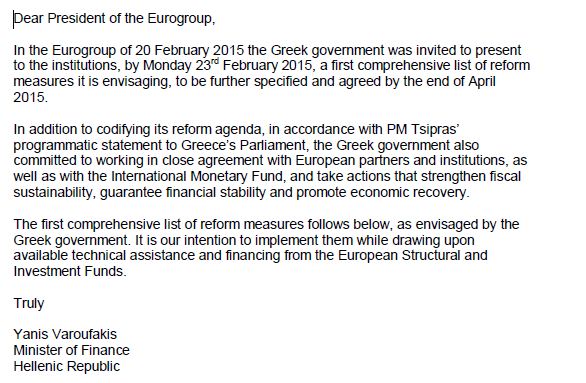
Greece’s Minister of Finance Yanis Varoufakis released the proposed “first comprehensive list of reform measures [the Greek Government] is envisaging”. This list has been submitted to the EUROGROUP for assessment and further processing.

GREEK GVT REFORM AGENDA-INTRO.24.02.15.pdf

It is well structured although it is more of a policy manifesto than a “technical” document for financial ministers (the EUROGROUP members) to financially assess.  Before approved as final, this document needs to be reviewed by the EU, IMF and the ECB (formerly known as TROIKA, currently referred to as “the Institutions” as well as the 19 Eurozone Governments.

Continue reading “Reformed Government Reform”

Reformed Government Reform

Mother of all Kolotoumbas

Dear readers. KOLOTOUMBA needs two days to process the Eurogroup statement released on Friday 20 February. In the meantime please provide your comments.

Here is the entire statement:

Eurogroup statement on Greece

The Eurogroup reiterates its appreciation for the remarkable adjustment efforts undertaken by Greece and the Greek people over the last years. During the last few weeks, we have, together with the institutions, engaged in an intensive and constructive dialogue with the new Greek authorities and reached common ground today.
Continue reading “Mother of all Kolotoumbas”

Mother of all Kolotoumbas

Yes, Master FAFA

According to the man, Jeroen Dijsselbloem,  himself:

@J_Dijsselbloem
“Received Greek request for six months extension”

The actual text has been reported by @Reuters as well: http://www.reuters.com/article/2015/02/19/eurozone-greece-request-idUSL5N0VT2S720150219

Yanis Varoufakis, Minister of Finance:

In this context, the Greek authorities are now applying for the extension of the Master Financial Assistance Facility Agreement for a period of six months from its termination during which period we shall proceed jointly, and making best use of given flexibility in the current arrangement, toward its successful conclusion and review on the basis of the proposals of, on the one hand, the Greek government and, on the other, the institutions.

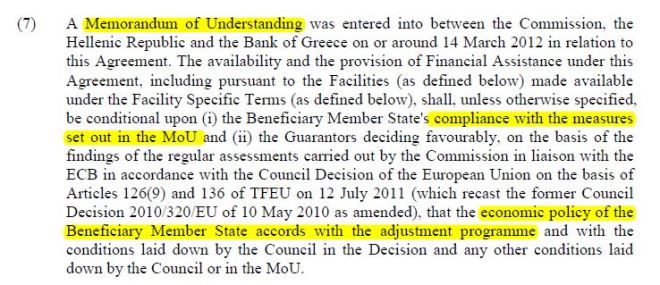
This extension refers to the MASTER FINANCIAL ASSISTANCE FACILITY AGREEMENT (MFAFA).  So following KOLOTOUMBA’s search for the definition of what exactly is Greece requesting as an “extension”, we reviewed the MFAFA (available here for all readers who want to dig more: MASTER FINANCIAL ASSISTANCE FACILITY AGREEMENT.12.12.12) and it is clear that it is tightly bound to the dreaded MNIMONIO (Memorandum of Understanding – MoU).

mfafa-page-5
Page 5 of the MFAFA

Outcome: Double KOLOTOUMBA:

  1. The TROIKA is here to stay but with a different name,  “THE INSTITUTIONS“. The ECB, IMF and the EU are still the supervisory bodies.
  2. The MNIMONIO is also here to stay for at least six months more. The INSTITUTIONS will still need to supervise and approve any regulations that may affect Greece’s fiscal surplus.

UPDATE: Eurozone finance ministers are due to meet on Friday 20 February in Brussels to discuss the Greek request. However the German Finance Ministry Spokesman Martin Jaeger released the following statement: “The Greek government is trying to agree bridge-financing without meeting the conditions of its existing rescue program. The request is not a substantive proposal for a solution”.

Greece and the entire Eurozone are in desperate need of a KOLOTOUMBA, this time  by the Germans themselves, to avoid a global monetary melt-down.

Yes, Master FAFA

But can I borrow outside of a program?

The latest update is that the Greek Government, on Wednesday February 18  Thursday February 19, will follow-up the ultimatum set by the EUROGROUP two days earlier with a “request for a loan extension”. The EUROGROUP clearly stated that they expected a “request for a program extension”.  Government officials in Greece have been making this LOAN/PROGRAM distinction very clear.

Let us step back one step:  As we presented last week, in 2010  Greece signed with the INSTITUTIONS (formerly knows as THE TROIKA – EC/ECB/IMF) the “Economic Adjustment Program for Greece”, a memorandum of understanding on financial assistance to the Hellenic Republic in order to cope with the Greek government-debt crisis.

It is this “financial assistance” that is termed now as a “loan” and for which the Greek Government is (allegedly) requesting an extension.

But by having a closer look at the actual “Economic Adjustment Program for Greece” we will read that:

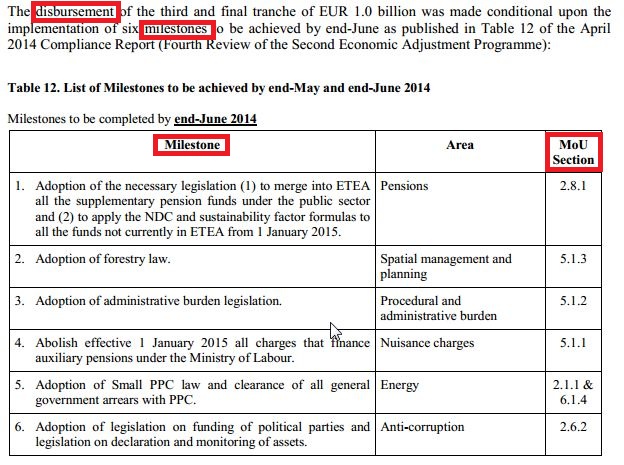
The release of each disbursement to Greece must be approved by both the Eurogroup and the IMF’s Executive Board. Prior to this decision, the European Commission, the ECB and the IMF staff conduct joint review missions to Greece in order to monitor compliance with the terms and conditions of the Program.

In simplified terms, each loan installment is to be given to Greece when the Government has met a set of milestones clearly linked to specific paragraphs/terms of the MEMORANDUM OF UNDERSTANDING (a.k.a. MoU a.k.a. – God forbid – MNIMONIO) the governing document of the Program.

The following is an excerpt of an actual EC/ECB/IMF report of 11 August 2014.
troika-report-excerpt

Notice the close links of DISBURSEMENTS, MILESTONES and the MOU?

OUTCOME:  Although not yet official, there is no legal background to ask for the EC/ECB/IMF to extend the LOAN disbursements without linking them to the specific PROGRAM and the MoU sections.  Some sort of KOLOTOUMBA is to be expected by either side.
But can I borrow outside of a program?

So How Red Are Those Lines?


Red Line

It all comes down to this:

Yanis Varoufakis: Faithful to the principle that I have no right to bluff, my answer is: The lines that we have presented as red will not be crossed. Otherwise, they would not be truly red, but merely a bluff.

This was the Greek Minister’s of Finance punchline in his op-ed article for the New York Times, published on February 16, just two hours before he entered a tough EUROGROUP meeting to discuss how Greece and its borrowers will “negotiate” the Debt (quotes are necessary since according to the Greek Government, this is not a “negotiation” but a “deposition of different views”).

Source: http://mobile.nytimes.com/2015/02/17/opinion/yanis-varoufakis-no-time-for-games-in-europe.html

So what are these “RED LINES” that the Government is drawing? According to reports leaked over the weekend:

  1. Value Added Taxes: Greece has a multitude of VATs depending on product/service offered and the region of the seller. Higher VATs result in higher income for the Government, however an increase in VAT makes a product less affordable thus leading to fewer sales. This has been an on-going chicken-and-egg debate ever since Greece entered the Financial Assistance Program.
    Red Line: No change in VATs. Current VAT percentages must remain “as is”
  2. Overtime compensation and Per-Diem expenses of Government Employees: Over the past years, public servants working in ministries, local governments, universities, public schools, etc, have seen their salaries reduced by approximately 35%. They have also suffered by the elimination of some weird bonuses such as “Bonus for Showing-up at Work On-time” and “Bonus for Washing Hands”.
    Red Line: Compensation for working overtime and allowance fees for travelling off-site shall remain “as is”
  3. Lay-off policy in the private sector: Back in the pre-austerity days, the law prohibited employers to fire more than 2% of staff over a period of one month. The reforms of the last years have made it easier for entrepreneurs to plan their work-force according to the market reality.
    Red Line: The Government needs to control all matters regarding lay-offs in the private sector.
  4. Employees’ rights to form trade unions and participate in strikes: The “INSTITUTIONS” (formerly known as TROIKA) want to impose limits to unions
    Red Line: This is a Radical Left led Government. Unions and Strikes are SYRIZA’s bread and butter. No changes whatsoever.
  5. Pension Reforms: The “INSTITUTIONS” demand that supplementary pensions should be limited, government should subsidize less in pension funds and public insurance agencies should establish zero deficit.
    Red Line: No change in laws regarding pensions and the relevant public insurance agencies.

KOLOTOUMBA Outcome: Remains to be seen but it does not look good…

So How Red Are Those Lines?

He-Who-Must-Not-Be-Named: THE TROIKA


troika-go-home

Harry Potter fans very well know that in the series’ early books, Lord Voldemort (Harry’s archenemy for you Muggles) was too fearsome to even be mentioned by his name. Wizards at Hogwarts (the Wizard school for you Muggles – enough already) referred to him as “He-Who-Must-Not-Be-Named“.

Well the Greek Government has now its own He-Who-Must-Not-Be-Named or rather “It-Who-Must-Not-Be-Named“:

The TROIKA

If we were allowed to pronounce it (it will be banned by law anytime now) we would read it as Tro-ee-ka (rhymes with Perestroika).

But what is/was the TROIKA?

According to wikipedia the TROIKA is: The tripartite committee led by the European Commission (Eurogroup) with the European Central Bank and the International Monetary Fund, that organised loans to the governments of Greece, Ireland, Portugal, and Cyprus. Together these three international organisations representing the bailout creditors, became nicknamed “the Troika”.

Well the TROIKA has been declared officially as dead by many Greek government officials including the Prime Minister Alexis Tsipras during the press conference following the European Union Summit on February 12:

The Troika is over“, said Alexis Tsipras

Source : http://www.euractiv.com/sections/euro-finance/troika-over-declares-confident-tsipras-council-summit-312087

Outcome: The TROIKA may be over but on Friday 13 February several Greek bureaucrats are holding “technical” discussions in preparation for the next EUROGROUP with the following individuals (all of which were members of the It-Who-Must-Not-Be-Named).

  • Rishi Goyal from the International Monetary Fund.
  • Klaus Masuch from the European Central Bank.
  • Declan Costello and Thomas Wieser from the European Commission and the EU Economic and Financial Committee.

The TROIKA is dead! Long live the “European Institutions assisted by the International Monetary Fund

(we are desperately in need for a new nickname – leave your suggestion in the comments)

He-Who-Must-Not-Be-Named: THE TROIKA

Minister of State on kolotoumba


It seems that KOLOTOUMBA has evolved into a full-fledged political term.  During the recent mandate-vote discussions in the Greek Parliament, KOLOTOUMBA was mentioned several times by top state politicians originating from the entire range of parties.

On February 11, during the deliberations of the EUROGROUP (EG), journalists from all over the world, were anxiously awaiting a single tweet from one of the participants. Rumor had it that the Ministers of Finance of the EU could not agree on an written agreement endorsed by all EG members. Apparently, the Greek representatives would not allow for the term “extension” to enter the agreement because it would consist a – you guessed itKOLOTOUMBA (SYRIZA has rejected any extensions of the current reform aid/funding package and prefers a “bridging agreement”).

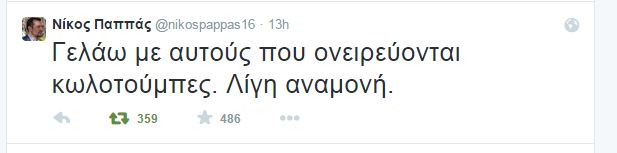
A little before midnight, the Greek Minister of State Nikos Pappas, considered by many as the right-hand (or rather the left-hand) adviser of Prime Minister Alexis Tsipras and allegedly in constant communication with the Greek EG representatives, tweeted the following;

n.papas-tweet-kolotoumba

I laugh at those who dream of KOLOTOUMBAs.  Just wait.

More on the EUROGROUP of 11 February 2015: http://www.ekathimerini.com/4dcgi/_w_articles_wsite1_1_12/02/2015_547181

Note for newcomers: KOLOTOUMBA is actually the unofficial Greek word for a back-flip or somersault performed by acrobats and gymnastics athletes.  In Greek political jargon it describes any change of a position on a specific policy, especially when it is a full 180- degree reverse.

For instance:

  • Position : Party Z will vote against legalizing recreational use of drugs
  • Outcome: Party Z votes for legalizing recreational use of drugs

Ergo KOLOTOUMBA


Minister of State on kolotoumba

OECD – Friend or Foe?


oecd logo

Ever since the dawn of the financial crisis in Greece, the Organisation for Economic Co-operation and Development (OECD) has offered its assistance to the Greek governments tackling reform and austerity.  This assistance has been provided through the so called “OECD toolkit” covering a bouquet of reform propositions across the public sector.

As an opposition party, SYRIZA has criticized the involvement of the OECD in many cases, too many to be covered in a single KOLOTOUMBA post.  Indicatively we refer to the case of reforms in education.

In August 2011, the OECD offered a report on Greece’s education policy based on addressing three major challenges.  The OECD Secretary-General, Angel Gurría, states in the Report’s foreward:

“To address the challenges, the government has established a bold agenda and sought advice from a task force on the development and implementation of reform proposals that reflect best practices in OECD countries. This report provides the outcomes of the work of the task force. It presents a roadmap for how the reforms can be successfully implemented, with pointers to relevant experience in other countries. The report stresses short-, medium-, and long-term actions that have the potential to generate efficiencies.”

Source: OECD (2011), Education Policy Advice for Greece, Strong Performers and Successful Reformers in Education, OECD Publishing.

Only last December, SYRIZA’s member Mr. Tasos Kourakis, who has just been appointed as  Alternate Minister of Education, stated in an article in the AVGI newspaper:

  • The OECD Education Policy Advice  is a liberal gospel for the TROIKA.
  • Its first challenge regarding “business development and human resource optimization” should be read as “lay-offs, staff assessment and increase in work intensity”.
  • Greece’s educational policy as implemented by the Ministry of Education is stipulated by international organisations and supervised by the TROIKA.
  • SYRIZA will fight with the education community to improve public education with no discounts and with no liberal interference.

Source: http://www.avgi.gr/article/5112597/to-upourgeio-paideias-%C2%ABektelei%C2%BB-kata-gramma-tis-upodeixeis-tou-oosa-tis-axiologiseis-tis-troika-kai-tis-desmeuseis-tou-mnimoniou

Outcome:  On 11 February 2015, Greece’s Prime Minister Alexis Tsipras and OECD’s Secretary-General, Angel Gurría met and agreed to work together on reforms.

Source: http://www.ekathimerini.com/4dcgi/_w_articles_wsite2_1_11/02/2015_547136


OECD – Friend or Foe?

So how about that Piraeus Port?

olp      cosco

The Port of Piraeus is one of the largest sea ports of the Mediterranean basin and has been the epicenter of Greece’s privatization efforts since 2008 when the government signed a 35-year concession contract with Cosco Pacific Limited for the management of the two main container terminals. This concession contract was recently extended to a third container terminal which would allow Cosco to implement a 230 million euro investment plan in the Piraeus port.

Source: http://greece.greekreporter.com/2014/11/27/piraeus-port-authority-and-cosco-sign-new-230-million-euro-agreement/#sthash.7mWw87DV.dpuf

In 2014 the previous coalition government, as part of its reform agreement with its borrowers (240-billion-euro EU-ECB-IMF bailout), issued an invitation to tender for the 67% control of the Piraeus Port Authority (also known as OLP by its Greek acronym).  SYRIZA, the radical-left lead opposition at the time, objected to this tender accusing the government that  they “were acting against the well being of the workers, small and medium enterprises and local communities” and that “SYRIZA promises that they will use all legal measures to maintain the public nature of the ports and that they will not accept any pre-made (fait accompli) decision“.

Source: http://www.avgi.gr/article/4989802/tmima-nautilias-o-suriza-den-tha-dexthei-tetelesmena-ston-o-l-p

Outcome: The new Greek coalition government led by SYRIZA is trying to negotiate an extension of funding (or “bridging agreement” depending on which side you ask) with the three borrowers in a tug of war which apparently includes the privatization of the Piraeus Port. The extent of the privatization remains to be decided but several government leaks tend to hint that there is no chance that the concession contract extension with Cosco will be cancelled and that the 67% privatization of OLP is still on the table.

Source: http://www.imerisia.gr/article.asp?catid=26516&subid=2&pubid=113453045

UPDATE: The Wall Street Journal seems to agree on this kolotoumba outcome (or “backtrack”):

Greece will proceed with the privatization of the country’s main port of Piraeus, Greek Finance Minister Yanis Varoufakis plans to tell his eurozone counterparts at a meeting in Brussels on Wednesday, backtracking on previous statements from the new leftist government that had pledged to freeze the deal, senior Greek government officials said.

Source: http://www.wsj.com/articles/greece-to-proceed-with-piraeus-port-privatization-1423573999

So how about that Piraeus Port?